
Arvind Sylva vs DNR Sarjapur Road
If you are looking at Arvind Sylva, the parcel about 1.93 km away by road has probably already come up. It is more than twice the land, it has roughly twice the homes on its filings, and it has no Karnataka RERA registration at all. Those three facts pull in different directions, and a buyer deserves to see them separated rather than blended.
This page is written from the Arvind Sylva side of the fence. It covers what has actually been filed for the neighbouring scheme and what those filings do and do not mean, what 865 additional homes on the same stretch would do to a 440-home tower, where the larger parcel could genuinely end up ahead, and what to do if you are waiting on it.
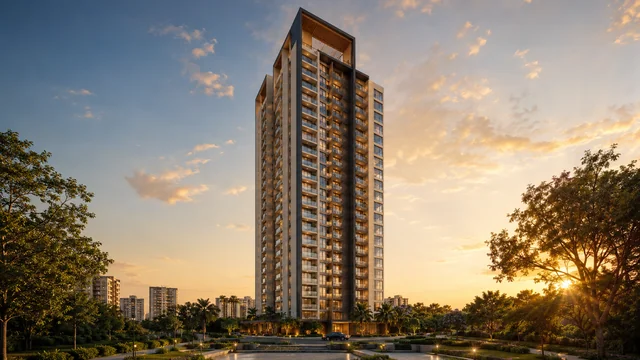
At a glance: Arvind Sylva vs DNR Sarjapur Road
| Factor | Arvind Sylva | DNR Sarjapur Road |
|---|---|---|
| Promoter on the certificate | Arvind Smarthomes Private Limited | DNR Corporation Private Limited, named as promoter on the filing |
| Registration | PRM/KA/RERA/1251/446/PR/090726/008800, valid to 31 August 2031 | None. No K-RERA number of any class |
| Approvals in hand | RERA registration approved 9 July 2026 | Terms of Reference granted 2 July 2026; clearance application under examination |
| Land | 5.0 acres, a 5 to 5.5 acre envelope | 11.86 acres on the granted Terms of Reference |
| Homes | Approximately 440 | 865, recorded in the Terms of Reference |
| Structure | One tower, 2 basements plus ground plus 18 floors | Not filed. Built form has not been drawn |
| Open and landscaped share | Above 85 per cent, per the developer | Not disclosed |
| Configurations | 3 BHK 1,500 to 1,800 sq ft; 4 BHK 1,900 to 2,300 sq ft | None published by the developer |
| Clubhouse | 15,000 sq ft over two floors, 40 plus amenity touchpoints | A clubhouse is in the filed scheme; no programme published |
| Entry price | Indicative from Rs 1.85 crore; Rs 12,500 to Rs 15,500 per sq ft blended | Not published |
| Developer standing | Arvind SmartSpaces Limited, listed and net-debt-free | Turnover Rs 385.27 crore and net worth Rs 73.50 crore in FY2024-25 |
What has actually been filed for the parcel next door
The neighbouring scheme is real, and the paperwork behind it is public. the state environmental authority granted a Standard Terms of Reference on 2 July 2026. It records 11.86 acres, 865 residences with a clubhouse, a proposed built-up area of 254,913 sq m and a project cost of Rs 350 crore. An environmental clearance application followed on 20 August 2026 and is under examination. All of it is on the public record, and the project overview on that scheme's own site walks through it line by line.
What matters for an Arvind Sylva buyer is understanding precisely what that stack of documents is. A Terms of Reference is the state agreeing the scope of the environmental studies a promoter must complete. It is a permission to investigate, not a permission to build. It fixes no unit mix, no tower count, no floor plate and no completion date. The environmental clearance that may follow governs air, water, waste, traffic and green cover - not the sale of homes.
The document that governs the sale of homes is the RERA registration, and the neighbouring project does not have one. That is why a comparison between the two is lopsided in a way the acreage column hides: on one side there is a filed unit schedule, a sanctioned plan, a declared completion date and a named promoter you contract with; on the other there is a granted scope of study for a building that has not been drawn, as its master plan page says in as many words.
What 865 more homes on this stretch would mean for you
Set the buying decision aside for a moment and think as an owner. If both schemes complete, roughly 1,300 households will have arrived on a two-kilometre stretch of Sarjapur Main Road, and the larger of the two will contribute about two-thirds of them.
The first effect is on the road itself. Sarjapur Main Road is already the corridor's chief constraint, and its capacity is the thing every buyer here underwrites whether they realise it or not. Two more entrance sequences feeding the same arterial is a real cost, and it is felt at the same two hours every weekday. Anyone assessing either scheme should drive the approach at 9 am on a working day rather than at noon on a Sunday, and should do it before signing anything.
The second effect is on resale, and it is more nuanced than it first looks. A large neighbouring scheme deepens the market: more transactions, more comparable evidence, more agents who know the micro-market, and a faster sale when you eventually want one. It also creates competition. If the larger scheme launches with a compact format, it will be selling into a price band Arvind Sylva does not occupy, which is less of a threat than a like-for-like competitor would be. If it launches with three-bedroom stock at scale, that competition is direct.
The third effect is on services, and it is the most reliably positive. Density is what brings a decent supermarket, a clinic that stays open past nine, and a school bus route that actually stops nearby. A 440-home tower on its own does not generate that. A 1,300-home catchment does.
One tower against a multi-block estate
The structural difference is bigger than the acreage difference and gets discussed far less. Arvind Sylva is a single tower of two basements plus ground plus 18 floors holding roughly 440 homes, with an open and landscaped share the developer puts above 85 per cent. The neighbouring parcel has not published a built form at all, but 865 homes on 11.86 acres cannot be delivered in one stack; it will be several blocks, and it will almost certainly be phased.
A single tower gives you one set of things: one lobby, one lift core, one facade, one handover date, one set of finishes, and a construction period that ends rather than rolling into the next block. It also concentrates the amenity into one clubhouse - here, a 15,000 sq ft two-storey building with more than 40 amenity touchpoints - rather than spreading it across a campus.
A multi-block estate gives you a different set: more distance between buildings, room for landscape that is used rather than looked at, and a maintenance corpus large enough to keep an ambitious amenity programme actually staffed a decade on. It costs you a longer construction horizon and, usually, years of living beside an active site if you buy into an early phase.
Neither shape is better. They suit different tolerances, and the tolerance that matters most is for construction noise you did not choose.
Where the neighbouring scheme could end up ahead
It would be dishonest to write this page as though the registered project wins on every axis. Three things could go the other way once the larger parcel files.
First, format range. Arvind Sylva starts at three bedrooms and 1,500 sq ft, and there is no compact option. Campaign material for the neighbour describes a two-bedroom entry, and its floor plans page is explicit that the sizes shown there are indicative rather than filed. If that survives into a filed unit schedule, the larger scheme reaches a buyer segment on this stretch that Arvind Sylva structurally cannot, and it will do so with a much bigger inventory to sell into it.
Second, land per home. Eleven point eight six acres for 865 homes is a materially different density arithmetic from five acres for 440, and it is the kind of difference that shows up in how far your window is from the next building. Until a site plan exists, that is potential rather than fact - a large parcel can be planned badly - but the potential is real.
Third, the developer is not a lightweight. DNR Corporation Private Limited reported turnover of Rs 385.27 crore and net worth of Rs 73.50 crore in FY2024-25, holds nine Karnataka RERA registrations across seven schemes, and has delivered three of them. Its compliance record is unusually clean: two complaints across a register of more than fifteen thousand rows, with no Authority orders against it, as its developer profile sets out with the registration numbers. That is a smaller balance sheet than a listed developer's, and it is not nothing.
Set against all three is the same unresolved fact. None of it is contractable until a registration exists, and no registration exists.
What Arvind Sylva gives you that the neighbour cannot yet
The registered project's advantage is not a marketing claim, it is a list of documents that exist.
There is a registration number - PRM/KA/RERA/1251/446/PR/090726/008800, approved 9 July 2026 and valid to 31 August 2031 - which you can verify yourself on the Karnataka RERA portal in about a minute. There is a named promoter entity, Arvind Smarthomes Private Limited, so you know which company you are contracting with rather than which brand is on the hoarding. There is a filed unit schedule, so carpet area is measured against a statutory definition instead of a brochure diagram. There is a sanctioned plan on the public record. And there is a declared completion window the promoter is answerable for, which the developer indicates as 2029 to 2030.
Those documents change what your money is doing. On a registered project your payments sit inside a statutory framework with a defined escrow discipline and a defined remedy if the promoter fails. Money paid against an unregistered project sits outside all of it.
There is also a financing consequence that catches buyers out. Most lenders want a RERA number before they will process a home loan file on an under-construction purchase. On the registered project that is a formality. On the unregistered one it is a wall.
What to do if you are waiting on the bigger parcel
Plenty of buyers will want to see the larger scheme's numbers before committing, and that is a defensible position provided the waiting is done with a plan rather than a hope.
Watch two things. The first is the environmental clearance application filed on 20 August 2026; its movement through examination is public and is the leading indicator. The second is the K-RERA register itself, which is where a registration will appear if and when it is granted. Neither requires a channel partner to tell you about it, and neither should be taken on somebody's word; the price page on that site explains why it carries no rate of its own.
While you wait, be clear about what you are trading. Arvind Sylva's expression of interest is a paid Rs 2 lakh for priority selection, and priority selection is a real asset in a single-tower project where floor and aspect cannot be replicated. A tower has one south-east corner per floor and eighteen floors. If the units you would actually want are gone by the time the neighbour files, the comparison you were waiting for will have been decided by inventory rather than by merit.
The clean framing is this. If you need to transact this financial year, or your lender needs a registration number, there is one option on this page and it is the registered one. If your horizon is genuinely two years and you want the option value of a larger, denser, possibly cheaper scheme with a compact format, then waiting is rational - but wait against the register, not against a brochure, and do not pay anything into the parcel that has not been registered.
Comparing Arvind Sylva and DNR Sarjapur Road? Talk to us.
Our team can share dated cost sheets, current offers and a side-by-side breakdown for both projects so you can decide with real numbers. Most responses arrive within the hour during business hours.
Talk to a Sales ConsultantArvind Sylva vs DNR Sarjapur Road - Frequently Asked Questions
Is the project next door registered with K-RERA?
No. DNR Sarjapur Road holds no Karnataka RERA registration of any class. What it holds is a Standard Terms of Reference granted on 2 July 2026 and an environmental clearance application filed on 20 August 2026 that is still under examination. Neither is a RERA registration and neither permits a sale.
How far away is it?
About 1.93 km by road. The two parcels sit on the same stretch of the Sarjapur Road corridor, with Arvind Sylva at Sy. No. 42/2 and 42/3 in Mullur Village and the neighbouring scheme at Doddakannelli. The straight-line gap is far shorter than the driving distance, which is why we quote the routed figure.
Will 865 more homes hurt my resale value?
Not necessarily, and the effect runs both ways. More stock on the stretch means more competition when you list, but it also deepens the market, brings more comparable evidence, and pulls in retail, clinics and school routes that a single 440-home tower cannot generate on its own. The sharper risk is like-for-like competition in the same configuration and price band.
Should I wait for the bigger project before deciding?
Only if your horizon genuinely allows it. There is no registration, no unit schedule, no price and no completion date next door, and none of those can be contracted until registration is granted. Meanwhile floor and aspect at a single-tower project are finite - waiting can cost you the specific unit you wanted rather than just time.
Which one has the bigger clubhouse and amenity programme?
Arvind Sylva discloses a 15,000 sq ft two-storey clubhouse with more than 40 amenity touchpoints. The neighbouring scheme's filings record a clubhouse but publish no programme, so nothing there is comparable yet. On land alone the larger parcel could support more, but potential and a filed specification are different things.
How do I verify all of this myself?
Look up PRM/KA/RERA/1251/446/PR/090726/008800 on the Karnataka RERA portal and read the promoter name, unit schedule and completion date on the certificate rather than in a brochure. For the neighbouring parcel, check the K-RERA register for any registration against DNR Corporation Private Limited.